In the dynamic property market of Alicante and Murcia, current and prospective homeowners constantly face a fundamental question: is it more advisable to renovate or build from scratch? This decision, which may appear straightforward, involves a thorough analysis of economic, temporal, regulatory, and personal factors that vary significantly according to each project’s circumstances.
On the Spanish Mediterranean coast, particularly in the provinces of Alicante and Murcia, this dilemma assumes special significance due to the unique characteristics of the local property market, the availability of building land, and the climatic peculiarities that influence construction decisions.

The current property market landscape in Alicante and Murcia
The construction sector on the Spanish Mediterranean coast is currently experiencing a period of notable dynamism. According to data from the Official College of Technical Architecture of Alicante, the province has recorded seven consecutive years of growth in new housing, reaching the highest figure in 17 years in 2025, with 9,720 dwellings commenced in the last twelve months.
“The slowdown in the second quarter was purely seasonal, and construction activity remains at historically high levels,” comments Cristina Bordera, President of the College of Technical Architects of Alicante.
This construction boom coincides with a sustained increase in execution costs. The average construction cost has risen by 32% since 2018, currently standing at €576 per square metre in Alicante. However, these figures vary considerably depending on the district: whilst in Marina Baixa and Marina Alta the cost reaches €632 per square metre, in areas such as Baix Vinalopó it stands at around €477.
In the Region of Murcia, the landscape is equally dynamic, with regional legislation evolving to facilitate both new construction and the rehabilitation of existing dwellings. The recent Affordable Housing Decree marks a turning point by even contemplating the completion of unfinished buildings following the property crisis.
Cost analysis: new build versus renovation
Building from scratch: complete economic breakdown
Building a new dwelling on the Mediterranean coast involves various cost components that are fundamental to understand in their entirety:
Land cost (25-65% of total budget)
The first major outlay is land acquisition. In Alicante, prices vary dramatically depending on location: from €80 per square metre in developing areas to €200 in more sought-after zones. This factor alone can determine the economic viability of a new build project.
Construction cost (€1,500-2,000/m²)
In 2025, construction prices in Alicante range between €1,500 and €2,000 per square metre, with a similar range in Murcia (€1,400-1,900/m² depending on quality). For a standard detached dwelling of 150 square metres, this translates into a construction cost of between €210,000 and €300,000, excluding the land.
Pacheco Arquitectos, specialists in new build in Alicante, explain: “The price range is wide because it depends fundamentally on three factors: the complexity of the architectural design, the quality of the selected materials, and the level of energy efficiency one wishes to achieve.”
Professional fees (8% of total)
The services of an architect, quantity surveyor, and site manager represent approximately 8% of the total budget. For a 150 square metre project, this equates to around €100 per square metre or €15,000 in total.
Licences and procedures (4-5% of budget)
Major works licences, professional endorsements, geotechnical studies, and other administrative procedures account for between 4% and 5% of the execution budget. Additionally, one must consider:
- Tax on Construction, Installations and Works (ICIO): 3.2-4% of the budget submitted to the council
- Municipal fees and temporary bonds
- Connections to basic services (water, electricity, sewerage): approximately €600-1,000
Practical example: 200m² detached dwelling in Alicante
- Land (500m²): €50,000 – 100,000
- Construction (200m² × €2,000/m²): €400,000
- Professional fees: €22,400
- Licences and taxes: €14,000
- Connections and external finishes: €15,000
- Total estimated: €451,400
Comprehensive renovation: an economic viability analysis
Comprehensive renovation presents a different cost structure and, in many cases, is more controllable:
Renovation cost per square metre
In Alicante, the cost of a comprehensive renovation ranges between €750 and €1,700 per square metre, depending on the scope of the intervention and the quality of finishes chosen. In Murcia, the range is similar: €500-1,700 per square metre for renovations including structural interventions.
An architect specialising in rehabilitation in Murcia clarifies: “The cost varies enormously depending on the property’s state of conservation. A dwelling that only requires updating of finishes can cost €500-600 per square metre, whilst a complete rehabilitation requiring installation renewal and structural reinforcement can reach €1,200-1,500.”
Renovation cost components
- Demolition and rubble removal: €125-300/m² (approximately €1,500 for a 100m² flat)
- Masonry: €100-300/m² (construction works, rendering, tiling)
- Plumbing and electrics: complete installation renewal can amount to €8,000-15,000 in a standard flat
- Joinery: doors, windows and fitted wardrobes can represent €5,000-12,000
- Painting and finishes: €8-15/m² indoors, €10-20/m² outdoors
Renovation licences (3-5% of budget)
A comprehensive renovation of €50,000 may require between €1,500 and €2,500 in licences and permits. Many renovations not affecting structural elements can be processed through a responsible declaration, which significantly expedites timeframes.
Practical example: comprehensive renovation of 100m² flat in Alicante
- Renovation with standard quality (€1,000/m²): €100,000
- Licences and permits: €2,000
- Contingencies (advisable 10-15%): €10,000
- Total estimated: €112,000
Direct comparison: the price factor
For a similar surface area (150m²), the economic difference is significant:
- New build: €451,400
- Comprehensive renovation: €75,000 – 180,000 (excluding acquisition cost)
However, this comparison must be qualified by considering that:
- Renovation assumes one already owns the property or acquires it on the second-hand market
- The acquisition cost of an old property to renovate can range between €100,000 and €300,000 in established urban areas
Temporal factors: execution timeframes and administrative procedures
Time is a critical factor often underestimated in property project planning. Timeframes differ substantially between new build and renovation.
New build: a long-term process
Phase 1: Land acquisition and preliminary studies (1-3 months)
- Plot search and selection
- Urban planning and legal verification
- Deed execution and registration
Phase 2: Architectural project and licences (4-12 months)
This is one of the most critical aspects. In Murcia and Alicante, the time to obtain a major works licence can extend up to 12 months in complex cases, although in straightforward situations it can be reduced to 2-3 months.
“One of the main problems our clients face is temporal uncertainty in obtaining licences. In specially protected areas or non-developable land, timeframes can exceed a year,” comments an architect specialising in urban planning procedures in Alicante.
Phase 3: Works execution (8-12 months)
For a standard detached dwelling, the construction process usually lasts between 8 and 12 months. This timeframe can extend in more complex or bespoke projects.
Phase 4: Completion and handover (1-2 months)
- Final certifications
- First occupation licence
- Definitive utility connections
Total estimated timeframe: 18-30 months (1.5 to 2.5 years)
Comprehensive renovation: agility as a competitive advantage
Phase 1: Project and licences (1-3 months)
One of the great advantages of renovation is administrative streamlining. Many renovations can be processed through a responsible declaration, which drastically reduces timeframes. Even renovations requiring major works licences are usually resolved in 2-3 months.
Phase 2: Execution (3-7 months)
Works duration depends on the scope:
- Partial renovation (kitchen and bathrooms): 2-4 months
- Comprehensive renovation without structural changes: 3-5 months
- Complete rehabilitation with structural reinforcements: 5-7 months
Phase 3: Completion (2-4 weeks)
- Professional site cleaning
- Final corrections
- Certifications where applicable
Total estimated timeframe: 5-12 months
A technical architect in Murcia notes: “For someone who needs to move within a specific timeframe, renovation is usually the most practical option. We can have a completely renewed dwelling in 6 months, whilst a new build will hardly drop below eighteen months.”
Regulatory and urban planning considerations
Legal and regulatory implications constitute a decisive factor that can tip the balance towards one option or the other.
New build: navigating the regulatory framework
Urban planning limitations
Building from scratch involves respecting multiple regulations:
- Municipal General Urban Development Plan (PGOU)
- Technical Building Code (CTE)
- Regional accessibility regulations
- Environmental and territorial protection regulations
In the Region of Murcia, the Territorial and Urban Planning Law establishes specific requirements that can limit building possibilities in certain areas. For example, on non-developable land, restrictions are considerable and procedures are more complex.
Mandatory reserves
In some developments, there is an obligation to allocate a percentage of land to protected housing, which can affect the economic viability of certain developments.
Renovation: flexibility within existing limits
Permitted interventions
Renovation of existing dwellings generally encounters fewer regulatory obstacles, especially when:
- External volume is not modified
- Original structure is maintained
- There is no change of use
- The building is not listed or protected
Protected buildings: a special case
In historic quarters of cities such as Alicante, Murcia, Cartagena, or Orihuela, dwellings may be subject to heritage protection. In these cases:
- Special heritage reports are required
- External interventions are highly limited
- Administrative timeframes are considerably extended
- There may be obligations to maintain original constructive elements
An architect specialising in heritage rehabilitation comments: “In listed buildings, renovation is not only the sole possible option, but it must also be carried out with very specific conservation criteria. Paradoxically, this can raise costs above those of standard new build.”

Advantages of building from scratch
Building a new dwelling offers unique advantages that can justify its greater initial investment and longer timeframes.
Absolute customisation
Building from scratch allows for designing every aspect of the dwelling according to specific needs:
Perfect spatial distribution
- Optimal orientation of rooms according to use and sun exposure
- Room dimensions adapted to real needs
- Circulation flows conceived from the outset
- Integration of external spaces (terraces, porches, gardens)
Plot adaptation
Architects in Alicante and Murcia develop projects that harness the plot’s topographic characteristics:
- Dwellings adapted to slopes to optimise views
- Exploitation of level differences to create differentiated spaces
- Integration with the Mediterranean landscape
“When we design a new dwelling, we can create a perfect symbiosis between architecture and environment. This is especially valuable on the Mediterranean coast, where the relationship with the exterior is fundamental,” explains an architect specialising in bioclimatic dwellings in Alicante.
Energy efficiency from design
New dwellings in 2025 must comply with the Technical Building Code, which establishes very demanding energy efficiency requirements:
Superior thermal insulation
- Façades with high-efficiency insulation (6-10 cm thickness)
- Thermal bridges eliminated from design
- Joinery with thermal break and double or triple glazing
- Ventilated roofs with reinforced insulation
Efficient climate control systems
- Aerothermal systems and latest-generation heat pumps
- Solar photovoltaic installation provided for in the project
- Mechanical ventilation systems with heat recovery
- Integrated home automation for energy optimisation
These characteristics translate into A or B energy certifications, which means:
- Savings of 50-70% in climate control costs compared to old dwellings
- Greater thermal comfort throughout the year
- Lower environmental impact
- Immediate property appreciation
Construction warranties
New dwellings enjoy a very solid legal framework of warranties:
- Ten-year warranty: 10 years for structural damage
- Three-year warranty: 3 years for constructive elements
- Annual warranty: 1 year for finishes
These warranties, backed by mandatory insurance, offer peace of mind during the property’s first years.
Reduced maintenance costs
During the first 10-15 years, a new dwelling requires minimal maintenance:
- New installations with the manufacturer’s warranty
- Materials in perfect condition
- No need for unforeseen repairs
- Optimised energy consumption
Advantages of renovating an existing property
Renovation of existing dwellings presents its own attractions that explain its popularity in the Mediterranean market.
Privileged location
The greatest advantage of renovation is usually location:
Established urban centres
Old dwellings in historic centres of Alicante, Murcia, or coastal towns such as Torrevieja, Denia, or Cartagena occupy locations that would be impossible to replicate today:
- Proximity to services and shops
- Established transport connections
- Consolidated neighbourhood life
- Heritage value of surroundings
Seafront location
On the Mediterranean coast, many dwellings with the best views and sea access are constructions from the 60s-80s that require renewal but occupy privileged positions.
“We have clients who prefer to renovate an old flat on the seafront rather than build a new dwelling on the second or third line. Location is a value that cannot be created,” comments an architect specialising in rehabilitation in Torrevieja.
Optimised financial investment
Lower initial outlay
For the same habitable result, renovation usually requires between 30% and 60% less investment than building from scratch, especially if one already owns the property.
Faster return on investment
In properties intended for tourist or residential rental, renovation allows:
- Earlier start of income-generating activity
- Accelerated investment recovery
- Shorter financing period required
Reduced timeframes
As we have seen, comprehensive renovation timeframes (5-12 months) are significantly shorter than those of new build (18-30 months). This implies:
- Shorter external financing period
- Possibility of earlier occupation
- Reduction in alternative accommodation costs
- More agile adaptation to changes in personal circumstances
Sustainability and circular economy
Renovating instead of demolishing and building has a positive environmental impact:
Waste reduction
- Existing structural elements are utilised
- Less rubble generation
- Preservation of traditional quality materials
Lower carbon footprint
- Reduction in consumption of new materials
- Less materials transport
- Utilisation of existing resources
An architect specialising in sustainable rehabilitation in Murcia explains: “From an environmental standpoint, the best construction is one that already exists. Increasingly more clients value the sustainability component that rehabilitation implies instead of new build.”
Investment flexibility
Renovation allows for staggered investment:
Phased renovation
- First phase: main spaces (living room, kitchen, main bathroom)
- Second phase: bedrooms and secondary bathrooms
- Third phase: additional improvements and external spaces
This flexibility is especially valuable for those who need to adapt the investment pace to their financial situation.
Practical cases on the Mediterranean coast
To illustrate the different options, we analyse typical real cases in Alicante and Murcia:
Case 1: Young couple in Alicante – New build
Client profile:
- Professional couple, 35-40 years
- Possibility of temporarily living with family
- Budget: €350,000
- Priority: energy efficiency and bespoke design
Decision: Construction of 140m² detached dwelling
Investment:
- Land in residential area (500m²): €60,000
- Construction (140m² × €1,400/m²): €196,000
- Project and management: €20,000
- Licences and taxes: €12,000
- External landscaping and finishes: €25,000
- Total: €313,000
Result:
- Total timeframe: 20 months
- Energy certification: A
- Annual climate control cost: €600 (versus €2,000 in similar old dwelling)
- Energy savings valued at €35,000 over 25 years
Case 2: Family with children in Murcia – Comprehensive renovation
Client profile:
- Family with two school-age children
- Inherited dwelling in Murcia centre (120m²)
- Budget: €90,000
- Need for rapid occupation
Decision: Comprehensive renovation, maintaining base distribution
Investment:
- Comprehensive renovation (120m² × €650/m²): €78,000
- Licences and permits: €2,500
- Energy efficiency improvements: €9,500
- Total: €90,000
Result:
- Total timeframe: 6 months
- Improved energy certification: from G to C
- Maintained central location valued at €80,000
- Savings of 65% compared to equivalent new build
Case 3: Foreign investor on Costa Blanca – Mixed decision
Client profile:
- British investor, 55 years
- Search for holiday rental property
- Flexible budget: €400,000
- Priority: profitability and sea views
Decision: Acquisition + renovation of seafront flat
Investment:
- Old flat acquisition (85m²): €250,000
- High-standard comprehensive renovation (85m² × €1,000/m²): €85,000
- Furniture and decoration: €25,000
- Licences and management: €5,000
- Total: €365,000
Result:
- Total timeframe: 8 months
- Privileged location impossible to replicate
- Immediate start of holiday letting activity
- Annual gross profitability: 8-10% (versus 4-6% in second-line new build)
Sustainability and energy efficiency: decisive factor in 2025
Environmental awareness and rising energy costs have made sustainability a decisive factor.
New build: efficiency from the origin
New dwellings in Alicante and Murcia incorporate energy efficiency solutions from design:
Bioclimatic design adapted to the Mediterranean
- South orientation of main spaces for solar gain in winter
- Solar protections (pergolas, overhangs) to prevent summer overheating
- Cross ventilation harnessing sea breezes
- Thermal inertia through high heat capacity materials
High-performance installations
- Aerothermal systems that can reduce climate control consumption by up to 70%
- Photovoltaic installation dimensioned for self-consumption
- Rainwater harvesting systems
- LED lighting integrated with home automation control
Energy certification A
A new dwelling with A certification on the Mediterranean coast means:
- Annual energy consumption: 15-30 kWh/m² (versus 150-250 kWh/m² in old dwellings)
- Economic savings: €1,400-1,800/year in a 150m² dwelling
- Efficiency investment payback: 8-12 years
Renovation: modernisation opportunity
Comprehensive renovation allows the transformation of energy-inefficient dwellings:
High-impact interventions
- Thermal insulation of façades through ETICS (External Thermal Insulation Composite System)
- Replacement of joinery with high-performance models
- Installation renewal for efficient systems
- Installation of aerothermal or solar energy
Pacheco Architects, specialising in energy rehabilitation in Alicante, notes: “We can improve a dwelling’s energy certification from G to B with an additional investment of 15-20% over basic renovation cost, and this improvement pays for itself in 10-12 years.”
Grants and subsidies
In 2025, there are grant lines for energy efficiency improvements:
- Next Generation EU funds for energy rehabilitation
- Regional subsidies in the Region of Murcia
- Tax deductions in income tax for energy efficiency works
These grants can cover up to 35-40% of the cost of energy improvements in renovations.
The location factor: when renovation is the only option
The geography and urban planning of the Mediterranean coast mean that in many cases, location is the determining factor.
Urban land scarcity
In coastal municipalities such as Benidorm, Torrevieja, Denia, or Alicante itself, available building land is limited and expensive. Existing buildings already occupy the best locations.
Historic quarters: heritage and opportunity
The historic centres of Alicante, Murcia, Cartagena, Orihuela, and other towns offer dwellings with traditional architectural charm in unbeatable locations:
Characteristics of these dwellings:
- Constructions from the 18th, 19th, or early 20th centuries
- Load-bearing walls in stone or solid brick
- Generous ceiling heights (3-4 metres)
- Traditional interior patios
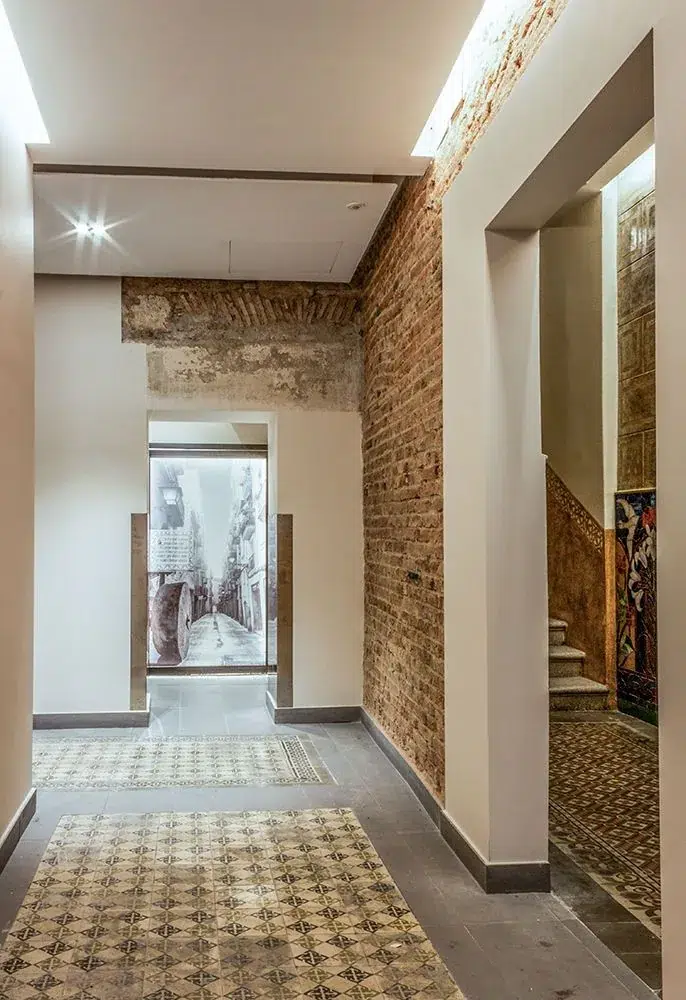
- Valuable architectural elements (mouldings, hydraulic floors, joinery)
“The historic quarters of our Mediterranean cities are an architectural treasure. Renovating these dwellings allows combining the charm of traditional architecture with modern comforts,” comments an architect specialising in heritage rehabilitation in Murcia.
Specific challenges:
- Protection regulations limiting interventions
- Absence of lift in many buildings
- Obsolete installations requiring complete renewal
- Complicated access for work
Opportunities:
- Moderate acquisition prices (30-40% less than equivalent new dwelling)
- Central location with all services
- Unique architectural character and personality
- Significant revaluation potential after rehabilitation
Seafront: irreplaceable value
Dwellings with direct Mediterranean views constitute a special asset:
Why renovate on the seafront:
- Impossibility of building new on the seafront in most municipalities
- Coastal Law restrictions on new buildings
- Location premium justifying renovation investment
- Sustained demand for both residential and tourist use
In towns such as Calpe, Altea, Jávea, or La Manga del Mar Menor, many owners choose to acquire old seafront flats and completely renovate them, obtaining a modern dwelling in a location that would be unattainable through a new build.
Conclusion: making the right decision for your project
The choice between renovation or building from scratch admits no universal answer. Each project requires an individualised analysis considering multiple interrelated factors.
Choose a new build if:
- You have time and flexibility for an 18-30 month project
- You prioritise energy efficiency and minimum long-term consumption
- You require a very specific distribution not found in existing dwellings
- You value the legal warranties of a new dwelling
- You can access building land in a location that satisfies you
- Your budget permits total investment (land + construction)
- You seek to minimise maintenance during the first 10-15 years
Choose renovation if:
- Location is your priority, and you have found a well-situated property
- You need an occupation in less than a year
- Your budget is tighter (30-60% less than new build)
- You value the architectural character of traditional constructions
- You already own a dwelling requiring updating
- You seek to optimise investment with faster return
- You prioritise sustainability criteria and the circular economy
Final recommendations from architects in Alicante and Murcia
Architecture professionals on the Mediterranean coast concur on several fundamental pieces of advice:
- Early professional consultation: Contacting Pacheco Arquitectos before making the decision allows correct evaluation of all options and their implications.
- Prior urban planning analysis: Verifying legal possibilities before acquiring a property to renovate or land to build prevents later surprises.
- Realistic budget with margin: Include an additional 10-15% for unforeseen circumstances, especially in renovations where hidden problems may appear.
- Long-term vision: Consider not only initial cost but maintenance and energy costs over 20-30 years.
- Quality over quantity: Both in renovation and new build, a smaller but well-executed dwelling is preferable to a larger one with poor quality.
“The best decision is one made with complete information and professional advice. Each project is unique and deserves a personalised analysis considering not only economic aspects but also the client’s life goals,” concludes Pacheco Arquitecto with extensive experience in both types of projects in Alicante.
Trends for 2025-2030 on the Mediterranean coast
The property market in Alicante and Murcia is evolving towards:
- Greater prominence of urban rehabilitation: Town councils incentivise historic quarter recovery over new peripheral developments.
- Increasing energy demands: European regulations push towards nearly zero consumption buildings, favouring both highly efficient new build and deep rehabilitation.
- Digitisation of procedures: Administrative streamlining especially benefits renovation, reducing licence timeframes.
- Appreciation of established locations: Sustainable mobility and remote working revalue urban centres over peripheral developments.
For those seeking to initiate a residential project in Alicante or Murcia, the recommendation is clear: seek a local architect who knows the Mediterranean market’s particularities in depth, specific municipal regulations, and the best construction solutions adapted to the area’s climate. Local experience makes the difference between a successful project and a problematic one. At Pacheco Arquitectos, we have more than 30 years of experience in Murcia and Alicante.
Whether renovating an architectural gem in Murcia’s old quarter or building a bioclimatic dwelling with Mediterranean views in Alicante, the future of residential architecture on the Mediterranean coast requires professional excellence, sustainability, and design adapted to the real needs of those who will inhabit these spaces.
Do you need advice for your project in Alicante or Murcia?
Pacheco Arquitectos, specialists in the area, can help you to:
- Evaluate the technical and economic viability of your project
- Analyse renovation versus new build options
- Optimise your budget according to your priorities
- Manage all administrative procedures
- Guarantee regulatory compliance and maximum quality
Investment in professional advice from the project’s inception is the best guarantee of success, whether you choose to renovate or opt to build from scratch on the privileged Spanish Mediterranean coast.