

There is a big difference between what you can do or can not do in you roof terrace if you are living in an individual house or you dwelling forms part of a community of owners. We explain the different procedures to follow in the more complicated situation i.e. your house or flat forms part of a community of owners.

If you want to have a barbecue or have a garden on the terrace, you should know that if you property forms part of a community of owners you will have to ask the community for permission as it that space it is considered communal space and therefor it belongs to everyone.
Here is Spain terraces are not only for summer but for most of the year. Having a terrace is a plus as we found out during the this pandemic, a breath of fresh air in the middle of the city where you can forget about cement and pollution. However, you should know that you cannot do everything you want on it, either by regulation, to avoid dangers and discomfort to the rest of the neighbors, or by simple common sense. What can and cannot be done on a penthouse terrace? We’ll tell you here.
Can I do what I want on my terrace?
Penthouses with a large terrace are among the homes most in demand by apartment buyers (triple the demand for another type of house). It is not surprising, because the terraces are a relief, a piece of nature in the middle of concrete and the noise of a city, and the perfect setting for an evening at almost all times of the year. But can you do anything you want in it?
Obviously not. The terraces, when form part of a block of flats, for a number of reasons. They are common elements (because they are roofed by the house or lower premises) for private use (because the owner of the house or premises from which it is accessed has its use and enjoyment). This private use has as consideration the obligation to keep it in good condition, Precisely, this double condition of common element and proprietary element prevents the owner from making abusive use of it.
Here are some activities that you can (or not) do on the terrace, with the help of the expert.
Can you have a barbecue?
• In principle, nothing opposes the use of a portable barbecue, except if the community prohibits it in its statutes or internal regulations.
• In general, there are no national regulations on this issue, although it may happen that some municipal regulations prohibit them for reasons of fire prevention, although those powered by electricity or gas are usually allowed.
• In any case, it is convenient to avoid causing inconvenience to neighbors, and although some might argue that it is an annoying activity due to the smoke and odors it causes, it is difficult for the courts to consider that it is an annoying or dangerous activity of those mentioned in the Article 7 of the Horizontal Property Law.
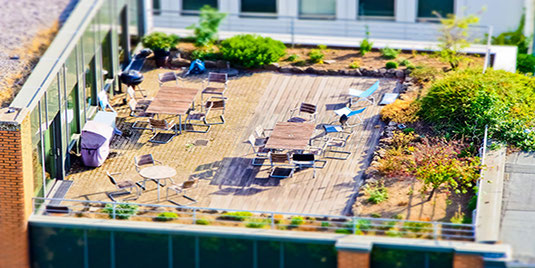
Can I have a portable swimming pool?
It will depend on the size of the pool. Please understand that a rubber pool of 2m by 1m deep when full of water weighs 2tons i.e. 1.000 Kg per sq, m so we recommend that you don’t do it unless you obtain expert advice from an architect. Apart from that it is possible that some community prohibits it in its statutes or in internal regulations.
However, as we have mentioned above building regulations establish that the slab must support 200 Kg / m2. Consequently, before its installation, a technical study of the building’s structure must be carried out, to know if the slab would withstand it.
As the terrace is a common element for private use, it will be necessary to request the permission of the community also.
The construction of a proper pool is much more difficult because it entails greater weight, modification of a common element and a municipal building permit.
Can I place plants on the terrace?
As for the plants, the following must be taken into account if you want to have a “garden” on the terrace:
• Pots can be placed without any problem (they are removable), but when we talk about pots, we are thinking of normal pots that a person can move them around.
• Large pots that need more than one person to move them are not valid. Why? We could have “the same problem as with swimming pools, that the load on the structure was higher than that calculated in the construction,” adds the expert.
• Inbuilt planters should not be built (they are fixed), because they are considered a common element modification, and furthermore, the roots could deteriorate the roof top.
In any case, you have to be very careful, “cleaning the dry leaves, eliminating the pruning remains and sweeping any blade of earth that comes out of the pots, to avoid that the sinks get clogged and a flood occurs on the lower houses ”.
Placement of furniture, swings.
• In general, you can have tables, chairs, loungers, umbrellas and clotheslines. That is, you can have furniture and fixtures, but they should to be movable.
• If they need fixings to the walls or the ground, they cannot always be placed, as they would be considered building works that will alter their original configuration, so they must have the favorable unanimous agreement of the entire community, in addition to a Optional report that guarantees the viability of the modification.
Lights on the terrace:
Well, yes, but with moderation.
You can install lights, but like all actions in the community, you have to do it trying not to cause inconvenience to any neighbor or increase the light pollution that we already suffer.
Please understand that here in Spain each city council, has its own municipal regulations, and it would be convenient to check them by asking at the town hall on the limits the luminous flux (the total amount of light that the light source produces in all directions ), because, in addition to causing light pollution, it can cause discomfort to the neighbours.
Can my children play on the terrace?
The answer is no. Noise is one of the most widespread annoyances, and should be avoided as much as possible, especially at sensitive times, such as siesta time, etc.
Skating or playing soccer are activities that should not be allowed on the terraces, apart from the noise, due to the deterioration that they can produce in the flooring, which leads to leaks and damage to the lower houses.

4 responses
Hola. We purchased a penthouse apartment in Costa Mijas a couple of years ago and recently realised that our Neighbours have access to their own roof and also ours. They claim it is on their deeds. However, we are also paying more in community fees when their percentage of footage with our roof taken into account will be considerably more. Also, the urbanisation is due to be repainted and again we are advised that we need to pay more than our Neighbours. Our Neigbours to the otherside also have private access to their own roof. Is this legal and who is responsible for any damage to our roof.
Hello Cathy,
After analising your problem of access to your roof I sugest the following:
1. Access to the Roof:
The fact that access to the roof is shared raises questions about whether your roof is actually for exclusive use or part of the community’s common areas. However, if your neighbours are using the roof without explicit authorization in the deeds or the community’s bylaws, they may be infringing on your rights as a property owner.
Recommended Steps:
• Review your property’s deeds and your neighbours’ deeds. Even though they are in Spanish, you could hire a sworn translator or a lawyer to help interpret them. The key is to identify whether the roof is categorized as private, for exclusive use, or communal.
• Consult the community’s administrator. They should have access to the community’s title deeds and bylaws, where the use of common areas and contribution quotas are defined.
2. Community Fees:
The fees you pay should be based on a participation coefficient, usually stated in the community’s title deeds. If you are paying more, it could be due to a larger area attributed to your property or an error in the calculation.
Recommended Steps:
• Request a breakdown of the participation coefficient from the community administrator to justify your fees.
• Request access to the community’s title deeds to verify whether your roof is included in the surface area used to calculate the coefficient.
3. Liability for Roof Damage:
Since your neighbours have exclusive access to the roof and use it, they could be held responsible for any damage caused by their usage, especially if this usage is not authorized in the legal documents.
Recommended Steps:
• In the event of future damage, document the roof’s condition with photographs and videos before any repairs are made. This will help assign liability if damage occurs.
• If the neighbors continue using the roof, you should consider sending them a formal notice (through a lawyer) requesting that they justify their access.
4. Cost Sharing for Painting:
If your property’s roof is considered part of a common area or is for exclusive use, the costs should be split proportionally according to the participation coefficients. Without access to the community’s title deeds, it is difficult to determine if the current distribution is correct.
Recommended Steps:
• Request a breakdown of the painting costs from the community administrator. This should reflect the coefficients and explain why you are paying more.
5. Situation with the Other Neighbors:
Notably, the other neighbours have exclusive access to their roofs. This suggests that the original design of the development might have contemplated private or exclusive-use roofs. However, to confirm this, you will need to verify whether their deeds reflect this exclusive access.
Recommended Steps:
• Request a copy of the community’s bylaws from the administrator. If they are uncooperative, you can request access through the land registry.
6. Immediate Actions:
• Hire a lawyer specialising in Horizontal Property Law. They can analyse your deeds, help you obtain community documents, and send formal notifications if necessary.
• Request a community meeting. Raise this issue during a meeting, as other owners may also be interested in clarifying the use and maintenance of the roofs.
Final Opinion:
The shared access to your roof and the fact that you pay higher fees may be due to an incorrect interpretation of the community’s title deeds or improper use by the neighbours. Until you obtain documents clarifying the roof’s legal status, it would be ideal to restrict the neighbours’ access if possible and seek legal support to protect your rights as a property owner.
I hope this is of help.
Please remeber that I am an architect so I suggest that you ccontact a solicitor specialized in the “Spanish Horizontal Law”
Juan
Hello
I recently bought a penthouse in Alicante. There is no roof on the private terrace. Some of the other penthouses have had glass roofs installed. The terraces are private.
I would like to have a glass roof on my terrace too. Do I need permission from the managing company/community?
Thanks,
Sonia
Hi Sonia,
There are two types of permissions you should obtain:
Permission from your local town hall:
In addition to getting permission from the community of owners (comunidad de propietarios), the owner would also need to obtain a building license (licencia de obras) from the Alicante local council (Ayuntamiento de Alicante).
In Spain, most structural modifications to buildings, especially those that alter the exterior appearance or involve construction work, require an official municipal permit. Installing a glass roof on a penthouse terrace would typically fall under this category.
The process generally involves:
1. Submitting a technical project prepared by a qualified architect or technical architect (arquitecto técnico)
2. Paying the corresponding municipal fees
3. Waiting for approval before commencing any work
There are usually two types of permits:
– Obra menor (minor work permit) – for simpler modifications (No structural work is involved)
– Obra mayor (major work permit) – for more substantial structural changes
A glass roof installation might qualify as either, depending on its complexity, size, and structural impact. The local building regulations (ordenanzas municipales) of Alicante would specify the exact requirements. Sometime a quick visit to your local town hall (Oficina de Urbanismo) can be the best action to take as they will be able to tell you exactly what you will require. Take with you photos of the façade, sketches of waht you want to do etc.
Proceeding without this municipal license could result in fines, a stop-work order, or even being required to remove the installation and restore the original condition at the owner’s expense.
Permission from your Managing company/community:
I would approach your question about installing a glass roof on your private penthouse terrace in Alicante with consideration for both technical and legal aspects.
The short answer is that yes, you very likely need permission from the community of owners (comunidad de propietarios) before installing a glass roof on your terrace, even though the terrace is private.
In Spain, modifications to the exterior appearance of buildings in a community typically require approval because they affect the overall aesthetic of the building. This is governed by the Horizontal Property Law (Ley de Propiedad Horizontal).
Before proceeding, I would want to ask you:
1. Have you checked the community statutes (estatutos de la comunidad)? These often contain specific rules about modifications to terraces and roofs.
2. Do the other penthouses with glass roofs have documented approval for their installations?
3. Is your terrace technically classified as a private-use common element (elemento común de uso privativo) rather than fully private property? This distinction matters legally.
I would recommend first reviewing your deed (escritura) and the community bylaws, then approaching the community administrator (administrador de fincas) with a formal proposal including technical drawings. The proposal would typically need to be approved at a community meeting (junta de propietarios).
This cautious approach helps avoid potential fines or even being required to remove the installation later.
I hope this is of help.
Juan